September 5, 2026
The Beginning of History
We should make it count
Some thoughts on reading "The Beginning of History", an essay William MacAskill published in Foreign Affairs. You can read it here. I think it's one of the most worthwhile things I've read this year, so please give it a go!
The Sinking Ship
Many people around me have quietly given up on the world. Pick your crisis: climate change, AI doom, wealth concentration, the erosion of functioning democracies. Whichever one keeps you up at night, the conclusion tends to be the same. The world is going downhill, and the future has nothing good in store for humanity. So people behave like passengers on a sinking ship. Some stop trying to fix it. Some stop thinking about the future altogether, even in their own lives. Why plan for a tomorrow that isn't coming?
I don't hold this against anyone. The crises are real, there are plenty of reasons to believe things will only get worse from here, and I have to confess that I've often resigned too, acting as if the future of humanity and the planet was lost either way.
Then a single statistic knocked me out of it.
Seven Hundred Thousand Years
To be fair, it wasn't MacAskill's essay itself at first. It was one number from it, which I stumbled upon in another article citing him:
A mammal species lives, on average, for around one million years. Humans have been around for roughly 300,000. Do the crude arithmetic, and humanity has about 700,000 years left on the clock. Now assume the human population declines dramatically, all the way down to just one billion people. Even then, over 700,000 years, that adds up to about ten trillion people who remain to be born.
Ten trillion. For every person who has ever lived, roughly a hundred are still waiting for their turn.
Of course, one could object. The one-million-year average was derived from the past and doesn't have to hold for the future. It certainly wasn't calculated for a species busy destroying its own habitat. Fair enough. But I would argue two things. First, even if humanity survived for "only" another 100,000 years, that would still be a spectacular future by any measure. Second, the case for humanity outlasting the average mammal is much stronger than the case against it. No other species collaborates at planetary scale, and no other species builds sophisticated technology. MacAskill takes this further: we might live for another hundred million years, until "the expanding sun scorches the earth". And if we ever become a space-faring species, tens of trillions of years could lie ahead of us.
MacAskill goes on to use this insight to argue that we should focus on eliminating catastrophic risk. A near-extinction of humanity, whether through nuclear weapons, climate change, or an engineered pandemic, would erase those ten trillion people before they ever got to exist. I won't go into this part yet. I currently don't believe the odds of human extinction through these threats are as high as MacAskill does, and I'm about to read his book What We Owe the Future, after which I'll hopefully have a more sophisticated opinion. But here's the thing: no matter what value you place on avoiding global catastrophe, there is enormous value in the insight itself. Ten trillion people remain to be born.
Two Stories
It's easy to believe the mainstream story that we are living through the end of history. It goes something like this: countless generations before us made great sacrifices and produced great innovations. We inherited all of it, used it to live in unprecedented wealth and comfort, and in the process trashed the planet and left it worse for everyone who comes after. Birth rates are falling because nobody sees a positive outlook for the next generation (a claim I don't buy, and I'll write a separate article on it). Eventually, humanity just fades away by ceasing to reproduce. I wouldn't know a place where this narrative is written down in exactly this way, but pieces of it show up in almost every doom scenario I hear.
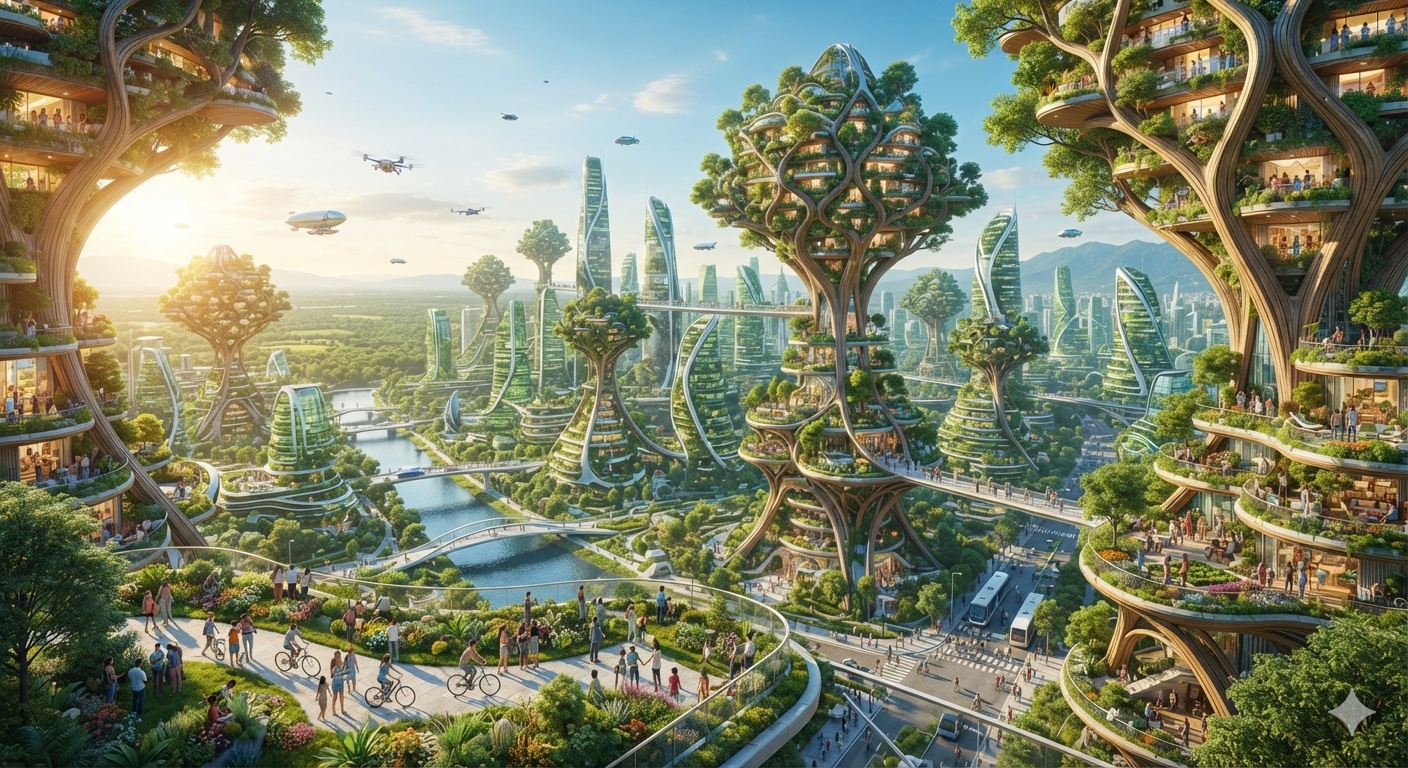
It's much more difficult, but also so much more encouraging, to believe the other story: that we stand at the beginning of history. That there are many thousands, possibly millions, of years ahead of us and trillions of humans still to be born. Consider what that implies. Some people, 100,000 years from now, will look back at us the way we look back at the first humans who painted animals on cave walls. They will consider us ancient. They'll find our tools primitive and our habits strange. And yet, if things go well, they will admire us for the sophisticated thoughts we managed to develop with the little we had, the same way we still marvel at those early paintings. We are not the last chapter. We are somewhere in the first few pages.
This story is encouraging because it takes away some of the worries about the future and replaces them with optimism. Because it motivates us to act in consideration of future generations, and to fight for making the world a better place than it currently is. It replaces the fear of bringing children into a world that is only going downhill with the pride of gifting them a life of (predominantly) joy and pleasure, in a future in which humanity will thrive.
The Catch
Here's why this story is more difficult to believe: it puts responsibility on us. If ten trillion people are still to be born, then their well-being is, in part, in our hands. And the sheer size of the number changes the math of everyday choices. When that many people are still to come, even a small action today can have an enormous impact on future lives.
Take one example. A modest donation to an organization working on eliminating lead from the environment could improve the chances of lead being banned worldwide. That, in turn, spares countless future children exposure to lead during the most critical phases of their development. Multiply a small benefit by trillions of lives and it stops being small. The same goes for a critical idea, or an innovation to a technology that we develop during our work: it can have enormous effects, both positive and negative, on the people of the future. And the same goes for how we live. The choices we make today, from what we consume to what we build, compound over trillions of lives.
Taking that responsibility seriously, by actively working or donating towards good causes, and by adjusting our lifestyle to one that isn't detrimental to the well-being of future humans, is what believing in the beginning of history asks of us. I think that's a small price to pay for trading resignation for optimism.